The Ambleside Natural History Society meets in a spirit of friendship and goodwill to share in all aspects of natural history, geology, the countryside, its scenery, its flora and fauna, its use, its buildings, its history, the activities of its inhabitants, etc. Almost nothing is excluded.
Non-members are welcome to attend our meetings at a charge of £3.
Next Meeting
Thursday 12 November 2026 at 7:30pm
Percival Lecture Theatre, University of Cumbria Ambleside Campus
Mostly Bearing North
Simon Roberts
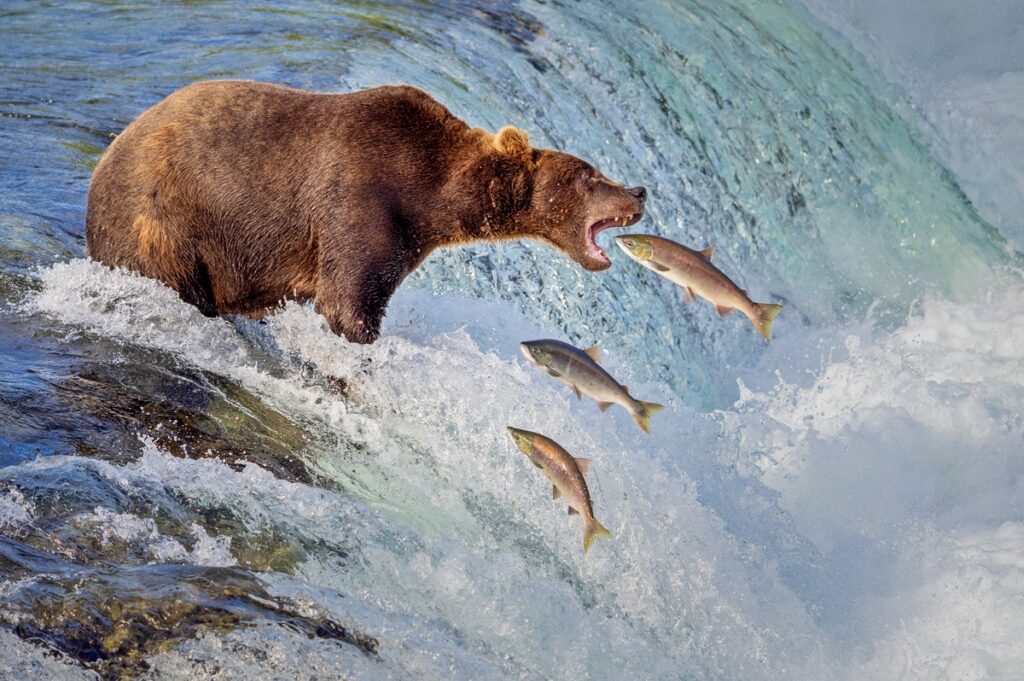
I have a passion for wildlife photography, but especially bears, whether they be black, brown or white. I’ll share my images from where I have been fortunate to see them around the world, along with an amateur’s understanding of some of their physiological quirks. My portfolio is at www.dramatic.photo.
A plan of the Ambleside Campus can be found at this link.
The Percival Lecture Theatre is in the Langdale Building, number 5 on the map. Our alternative meeting venue is the Beehive, building number 2 on the map.
Turn in to the campus at The Armitt Museum, park in the car parks about 50m up the hill (free in the evenings) then walk a little further up the hill. The Beehive is the single storey building on your right, the Langdale Building is slightly further, up the steps to the flat area and is again on your right.
The committee always welcomes suggestions for future talks and comments on what we are doing; or if you want to become a member email us at anhs@anhs.org.uk.
Our programmes for previous years are available at the heading tab.
Summer field trips
24 September 2026 – Bat walk led by Rich Flight
Rich Flight is a Cumbrian bat expert and he brought along a number of simple bat detectors for us to use as well as an infrared camera that projected onto a laptop, and a frequency analyser with which he showed us how to recognise different species from the way each bat chirp scans through a wide frequency range, well above the range of human hearing.
Walking around the church before it was fully dark, we saw and identified common and soprano pipistrelle using the simple detectors. We then moved down to the river at Miller Bridge where we followed a Daubenton’s bat flying back and forth just above the surface for perhaps half an hour using the infrared camera, plus a brief appearance of a noctule bat. During the stops Rich told us more about bats and his own experiences and answered the many questions put to him.
Undoubtedly one of our best field trips to date, well over forty members and students attended.
8 June 2025 – Plant identification on Loughrigg
Our most successful summer outing yet saw 20 members and visitors take a leisurely walk on Loughrigg identifying flowers with the help of Volker and David Harpley, until recently Conservation Manager at Cumbria Wildlife Trust. As part of the story we also learned a lot about how conditions in different areas of the fell influenced the plants that grow there.
Some photos taken by Volker can be found at this link.
16 June 2024 – Moth identification at Holehird Gardens

Several moth traps were set in different parts of the garden the night before and we checked them together in the morning with the help of moth expert Guy Broom who helped us identify the different moths we had caught.
Images of moths we observed can be found at this link.
Thanks to Steven Mees and the Lakeland Horticultural Society for letting us use the Holehird site
4 May 2024 – Walk in Skelghyll Woods
On a damp Saturday morning in early May around a dozen ANHS members walked the route of the 1966 Skelghyll Wood Nature Trail, designed by Ambleside Field Society. We saw lots of bluebells and ramsons; heard cuckoos and a variety of warblers; found a charcoal burning platform and toothwort (the subject of one of Harold Auty’s lovely woodcuts in the original leaflet) and looked at lichens such as Gyalecta jenensis in the old limestone quarry. In general, there are more, bigger trees than in the 1960s, and fewer wildflowers to be seen. Many of the more exotic trees have gone, however. There’s a lot more beech and holly. An interesting time was had by all: we’ll do more local walks in the future.


Swifts in Ambleside
Following a talk on swifts to ANHS by Peter Moreton in April 2019, Pete Martin set up a small group to monitor swifts and their nest sites in Ambleside each summer.
Click on the links to read Pete’s reports of their observations.